Insurance Advertisement Examples That Convert
Most insurance advertisement examples you'll find are useless for agents.
They show you GEICO's caveman commercials. State Farm's jingles. Allstate's mayhem character. These campaigns cost millions. They build brand awareness. But they don't generate leads for individual agents.
Insurance advertisement examples are real ads that insurance agents use to attract prospects, build trust, and convert viewers into booked appointments. The best examples use short video ads that educate prospects before selling, driving them to landing pages where they exchange contact information for valuable content.
Here's what actually works. And why.
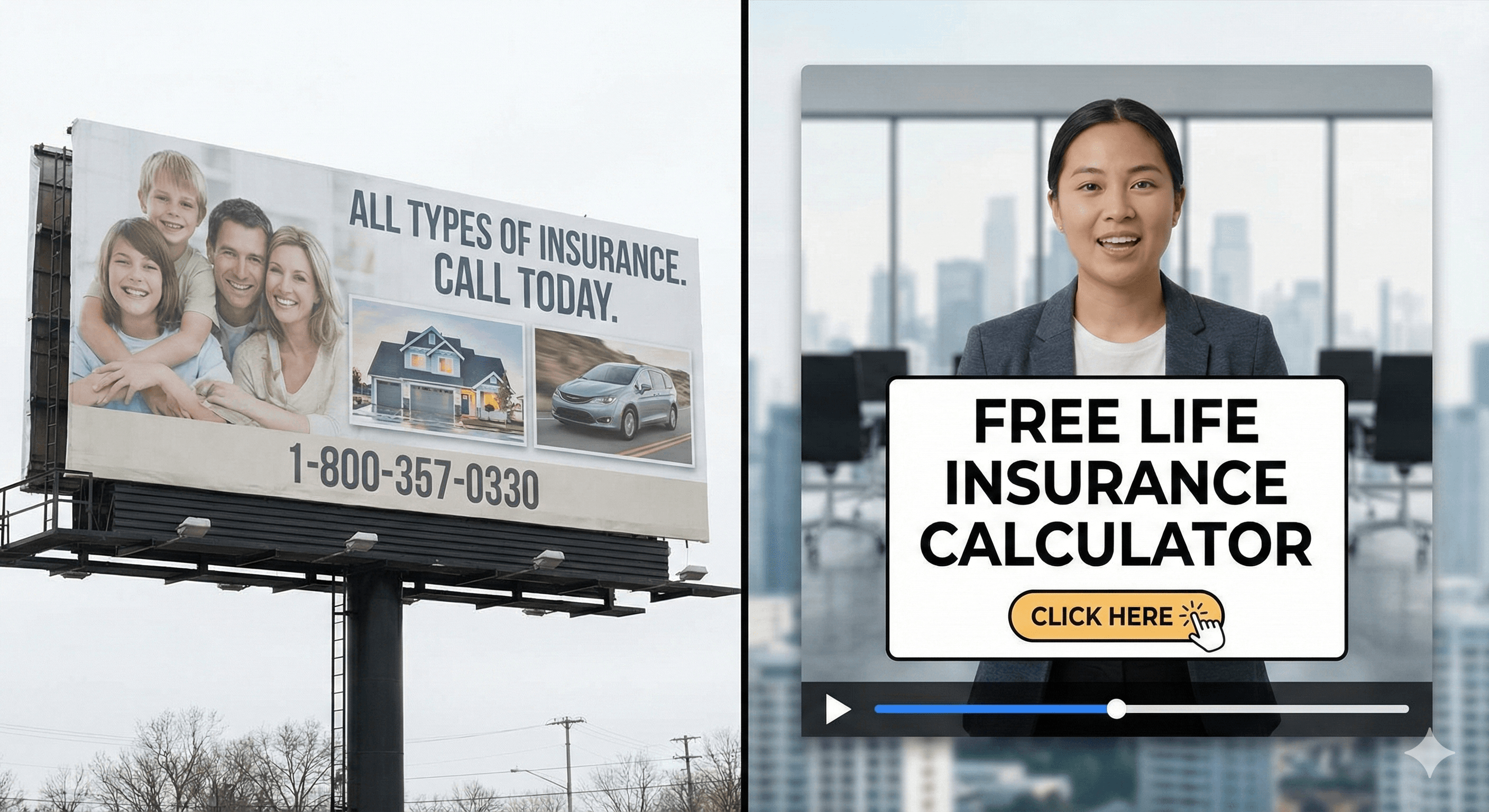
Most agents waste money on ads that build awareness but don't generate leads. There's a better way.
Why Most Insurance Advertisement Examples Fail
Big brand ads fail for agents because they have different goals.
Big brands want: Brand awareness. Market share. Top-of-mind recognition.
You want: Booked appointments. Qualified leads. Closed policies.
The difference matters. A GEICO commercial that makes you laugh doesn't make you call. It makes you remember GEICO when you're ready to shop. But you're not GEICO. You're an individual agent who needs results this month, not this year.
Here's what happens when agents copy big brand strategies:
The Billboard Problem:
You spend $2,000-5,000 per month on a billboard. Thousands of people see it. Maybe 10 people remember your name. Maybe 2 people call. Your cost per lead: $1,000-2,500. That's not scalable.
The Radio Problem:
You buy radio spots for $500-1,500 per month. People hear your name. But they're driving. They can't write down your number. They can't click a link. Your conversion rate: near zero. Your cost per lead: infinite.
The Generic Social Media Problem:
You post insurance tips on Facebook. You get 50-100 likes. But likes don't pay bills. You need contact information. You need booked appointments. Generic content builds awareness but doesn't generate leads.
The problem isn't the medium. It's the model. Big brands can afford awareness campaigns because they have massive budgets and long sales cycles. You need direct response campaigns that capture leads immediately.
The 5 Insurance Advertisement Examples That Actually Work
These examples work because they're part of a system. They don't just build awareness. They generate leads.
Example 1: The "Coverage Gap" Education Ad
The Ad Script:
"Most people don't realize their employer's life insurance only covers 1-2x their salary. If you make $75,000, that's $75,000-$150,000 in coverage. But your family needs 10x your income to maintain their lifestyle. Here's how to calculate what you actually need..."
Why It Works:
- Addresses a specific problem (coverage gap)
- Uses numbers (makes it concrete)
- Educates without selling
- Creates curiosity (how do I calculate this?)
The Landing Page:
Drives to a page offering "Free Life Insurance Needs Calculator." The page captures name, email, and phone in exchange for the calculator. This qualifies the lead. They're interested enough to download.
The Results:
- 3-5% of viewers click through
- 40-60% of clickers download the calculator
- 25-35% of downloaders book appointments
- Cost per appointment: $50-150
This ad works because it positions you as the expert. Prospects learn from you before they meet you. When they book, they're already sold on your knowledge.
Example 2: The "Cost Calculator" Offer Ad
The Ad Script:
"Everyone thinks life insurance costs $500 per month. It doesn't. For a healthy 35-year-old, $500,000 in coverage costs $25-40 per month. That's less than your Netflix subscription. Want to see what you'd actually pay? I'll show you in 60 seconds..."
Why It Works:
- Breaks a common misconception (high cost)
- Uses relatable comparison (Netflix)
- Creates urgency (60 seconds)
- Offers immediate value (free quote)
The Landing Page:
Simple form: age, health status, coverage amount. Returns instant quote. Captures contact information to deliver the quote. Follows up with email sequence explaining the quote.
The Results:
- 5-8% of viewers click through
- 50-70% of clickers complete the form
- 30-40% of form completers book appointments
- Cost per appointment: $75-200
This ad works because it removes the biggest objection (cost) before prospects even talk to you. They see the price. They're interested. They book to learn more.
Example 3: The "Common Mistake" Warning Ad
The Ad Script:
"The biggest mistake people make when buying life insurance? They buy the wrong type. Term insurance is for temporary needs (mortgage, kids' college). Permanent insurance is for permanent needs (estate planning, legacy). Most agents sell you what pays them the most, not what you actually need. Here's how to know the difference..."
Why It Works:
- Positions you as honest (most agents don't do this)
- Educates on a complex topic (term vs permanent)
- Creates trust (you're looking out for them)
- Differentiates you from competitors
The Landing Page:
Offers "The 5 Questions to Ask Before Buying Life Insurance" guide. Captures contact information. Delivers guide via email. Follows up with additional education.
The Results:
- 4-6% of viewers click through
- 45-65% of clickers download the guide
- 20-30% of downloaders book appointments
- Cost per appointment: $100-250
This ad works because it builds trust through honesty. Prospects see you're different. They want to work with someone who educates, not just sells.
Example 4: The "Life Event" Timing Ad
The Ad Script:
"Just had a baby? Congratulations. Now you need life insurance. But here's what most new parents don't know: you need 10-15x your income, not 2-3x. Your child will need support for 20+ years. Here's how to calculate the right amount for your family..."
Why It Works:
- Targets a specific life event (new baby)
- Addresses timing (they're thinking about it now)
- Provides specific guidance (10-15x income)
- Creates urgency (protect your family now)
The Landing Page:
Offers "New Parent Life Insurance Checklist." Captures contact information. Delivers checklist. Follows up with appointment booking link.
The Results:
- 6-10% of viewers click through (higher because of life event)
- 55-75% of clickers download the checklist
- 35-45% of downloaders book appointments
- Cost per appointment: $60-150
This ad works because it catches prospects at the right moment. They're already thinking about protection. You're providing the solution.
Example 5: The "Myth Buster" Education Ad
The Ad Script:
"Myth: Life insurance is too expensive. Fact: For a healthy 40-year-old, $1 million in term coverage costs $50-80 per month. That's $1.67-2.67 per day. Less than a cup of coffee. Myth: I'm too young to need it. Fact: The younger you are, the cheaper it is. Lock in low rates now. Here are 5 more myths that cost people thousands..."
Why It Works:
- Debunks common objections (too expensive, too young)
- Uses concrete numbers (makes it real)
- Creates curiosity (what are the other myths?)
- Positions you as the expert
The Landing Page:
Offers "5 Life Insurance Myths That Cost You Money" guide. Captures contact information. Delivers guide. Follows up with education sequence.
The Results:
- 4-7% of viewers click through
- 50-70% of clickers download the guide
- 25-35% of downloaders book appointments
- Cost per appointment: $80-200
This ad works because it addresses objections before prospects have them. They see the truth. They're interested. They want to learn more.
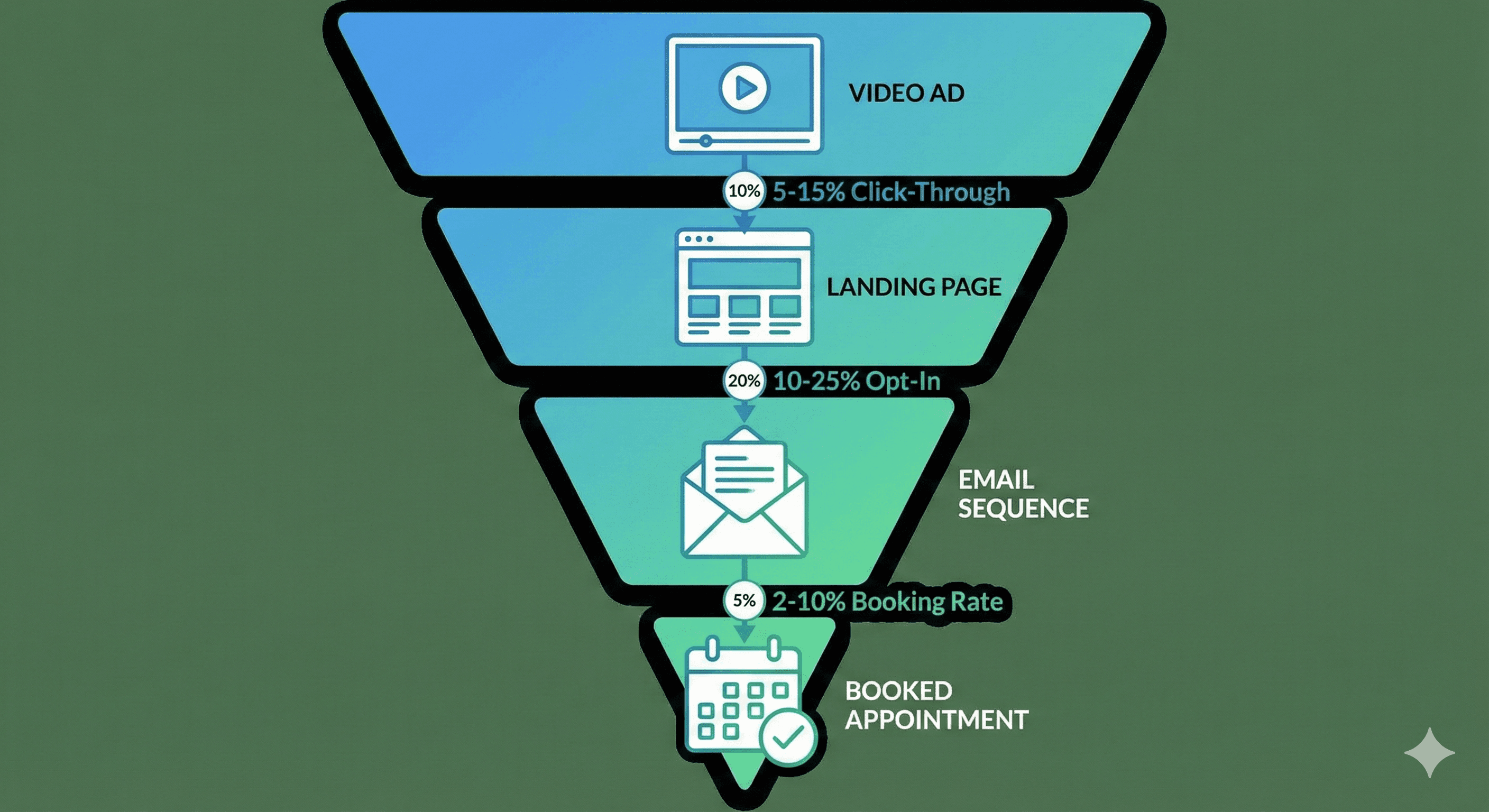
These ads work because they're part of a complete system, not standalone tactics.
The System Behind Successful Insurance Advertisements
These examples work because they're not just ads. They're part of a complete system.
The System:
- Video Ad (30-90 seconds) educates prospects on a specific topic
- Landing Page captures contact information in exchange for valuable content
- Email Sequence (5-7 emails) delivers the content and builds trust
- Booking Link appears in emails, inviting prospects to schedule
- Warm Appointment happens with someone who already trusts you
The ad doesn't sell. It educates. The landing page doesn't sell. It captures. The email sequence doesn't sell. It nurtures. The appointment is where you sell. But by then, the prospect is already 70% sold.
The Math:
- 10,000 people see your ad
- 400-700 people click through (4-7% click-through rate)
- 200-450 people download your offer (50-65% conversion rate)
- 50-135 people book appointments (25-35% booking rate)
- 20-68 people become clients (40-60% close rate)
Cost per client: $150-500. Compare that to buying shared leads at $2,500-5,000 per client.
The system works because it builds trust before asking for a sale. Prospects know you. They like you. They trust you. When they book, they're ready to buy.
What Most Agents Get Wrong About Insurance Advertisements
Mistake #1: Copying Big Brand Creative
GEICO's humor works for GEICO. It doesn't work for you. You need direct response ads that capture leads, not awareness ads that build brands.
Mistake #2: Selling in the Ad
Your ad shouldn't sell. It should educate. The sale happens in the appointment. The ad's job is getting them to the appointment.
Mistake #3: No Clear Call-to-Action
"Learn more" doesn't work. "Get your free calculator" works. Be specific. Offer value. Make it easy to say yes.
Mistake #4: Driving to Your Website Homepage
Your homepage has too many options. Drive to a dedicated landing page with one goal: capture contact information. Remove distractions. Focus on conversion.
Mistake #5: No Follow-Up System
Capturing a lead isn't enough. You need an email sequence that nurtures. Most agents capture leads then call them cold. That defeats the purpose. Automate the nurture. Then call them warm.
Mistake #6: Not Tracking Results
You can't improve what you don't measure. Track click-through rates, conversion rates, booking rates, and close rates. Optimize what works. Kill what doesn't.
The Two Paths to Creating Effective Insurance Advertisements
You have two options:
Path 1: Learn and Build It Yourself
This requires learning video production, ad copywriting, landing page design, and email automation. The upfront cost is time, but you own the system forever.
Our S.C.A.L.E. course teaches insurance professionals the complete framework for building branded lead systems. You learn how to create video ads, write ad copy, build landing pages, set up automation, and optimize for ROI.
Timeline: 60-90 days to see consistent results
Investment: Education cost + ad spend ($2,000-5,000/month)
ROI: Once optimized, you own a system that generates leads for years
Path 2: Done-For-You Service
If you need results faster, a done-for-you service builds and manages the entire system. You receive exclusive, warm appointments directly in your calendar.
We offer a done-for-you branded lead service that handles everything: ad creation, copywriting, landing page building, automation setup, and optimization. You focus on closing appointments, not learning marketing.
Timeline: 30-60 days to see consistent results
Investment: Monthly service fee + ad spend
ROI: Predictable cost-per-acquisition with minimal time investment
Both paths work. The choice depends on your timeline, capital, and long-term goals.
The Bottom Line: Stop Building Awareness, Start Generating Leads
Insurance advertisement examples from big brands are entertaining. But they don't generate leads for individual agents.
The examples that work focus on education, not entertainment. They're part of a system that builds trust before asking for a sale. They capture contact information. They nurture prospects. They convert at 25-40%, not 2-5%.
If you're ready to stop copying big brand ads and start generating real leads, get our free ad scripts to see how the system works. These scripts are designed to be filmed in minutes and address specific client pain points.
Or explore our done-for-you service if you want results without the learning curve.
The old model is awareness. The new model is leads. The only question is: when are you going to make the switch?